


Obtaining energy from renewable sources always also means looking for the right way to store it. Many users wonder which solution will prove not only effective, but also cost-effective. Energy stores are usually associated with electric batteries, but equally important — and often more accessible and efficient — are heat stores, that is buffer tanks.
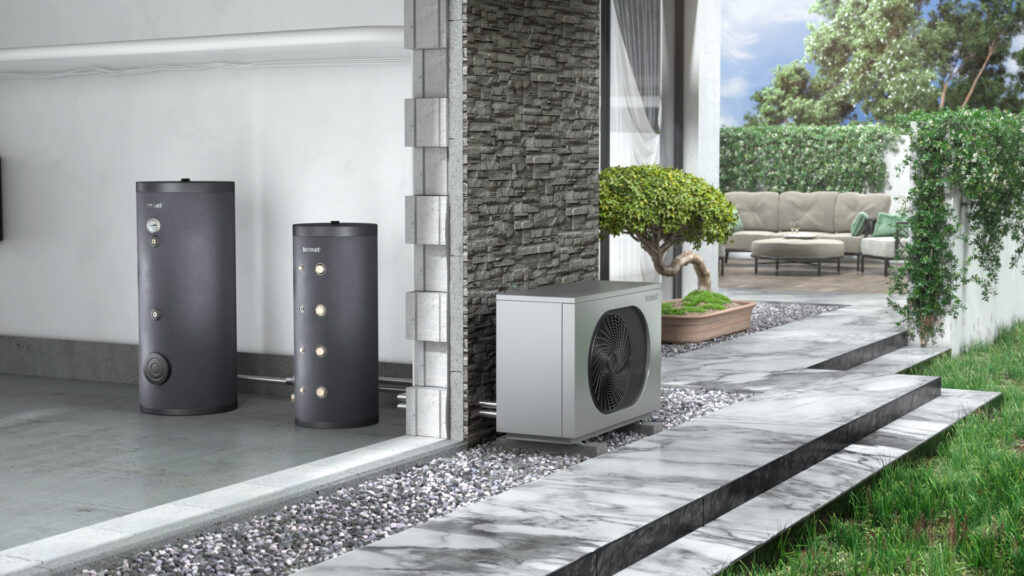
Optimal heat management is crucial not only for the efficient operation of the heating system, but also for limiting running costs. In modern installations, solutions that allow flexible use of the energy produced are increasingly applied. One of them is the buffer tank, which in some heating systems is downright essential.
What is a buffer tank?
The buffer tank is an intermediate element between the heat source and the heating installation. Its job is to store hot water produced while the heat pump or boiler is running and to release it when demand rises. Thanks to this the heat source can operate in a more continuous way, closer to optimal conditions, which extends its life and, in the case of a heat pump, increases the seasonal coefficient of performance (SCOP).
Why is it worth using a buffer tank in a heat-pump installation?
A heat pump is most efficient under stable conditions, with long operating cycles. Heat demand, however, is usually variable — which would cause the compressor to switch on and off frequently. Using a heat buffer tank stabilizes the water temperature in the installation and reduces the number of compressor starts. It additionally acts as a hydraulic separator for mixed heating circuits
How does a buffer tank affect appliance efficiency?
- Stabilizing heat-pump operation – reducing the number of compressor on/off cycles.
- Storing thermal energy – enables better use of surplus heat when demand is low.
- Improving user comfort – smoother temperature control in the heating installation.
- Increasing energy efficiency – thanks to more even operation of the heat source.
- Better management of several sources working together – e.g. a heat pump and a condensing boiler, which can supply heat alternately.
A heat buffer tank – when to use one?
An accumulation buffer tank is a good solution not only in systems where the heat pump is the only heat source. It will also work well in hybrid installations with a heat pump and a gas boiler. The buffer tank then optimizes boiler operation and helps lower heating costs.
A buffer tank is also advisable where there are large temperature differences between the heat source and the emitters — for example in installations with underfloor heating. Using a buffer tank is also a good solution when photovoltaics are in use — it will let you store heat at the time when electricity production from solar energy is highest, and use it in hours of lower solar gain.
TERMET Energy 100 – a proven accumulation buffer tank
A good example of an efficient heat store is the TERMET Energy 100. It is a compact 100-liter heating-water tank designed to work with heat pumps. Its construction enables efficient storage and release of heat, which translates into better performance of the entire installation. Thanks to thermal insulation and solid workmanship it provides long-lasting, trouble-free operation.
Using a heat buffer tank in a heating system is not only a technical necessity, but above all an investment in the stability, efficiency, and longevity of the entire installation. It is an easy way to manage energy in the building that does not require large investment outlay.
Learn more and see why it is worth using a heat buffer tank on our YouTube channel.